Car vs Bike in India: The Complete Guide to Choosing the Right Vehicle
How to compare total cost, daily usefulness, comfort, safety, finance, and long-term value before choosing a car or a bike.
Start With Your Real Need
The first mistake people make when comparing a car and a bike is comparing machines before comparing their lives. A vehicle is useful only when it matches the way you travel, the people you carry, the roads you use, and the amount of money you can comfortably spend every month. A bike can be inexpensive to buy and run, quick in traffic, and easy to park. A car can offer weather protection, more carrying capacity, more comfortable long journeys, and a safer enclosed cabin. Neither is automatically better. The better choice is the one that solves your transportation problem without creating a financial problem.
Begin by writing down your typical week. How many kilometres do you travel? How often do you carry family members? Do you travel in heavy rain, extreme heat, or poor roads? Do you regularly visit clients, schools, hospitals, or markets? Answers to these questions often reveal the right category before you look at any model.
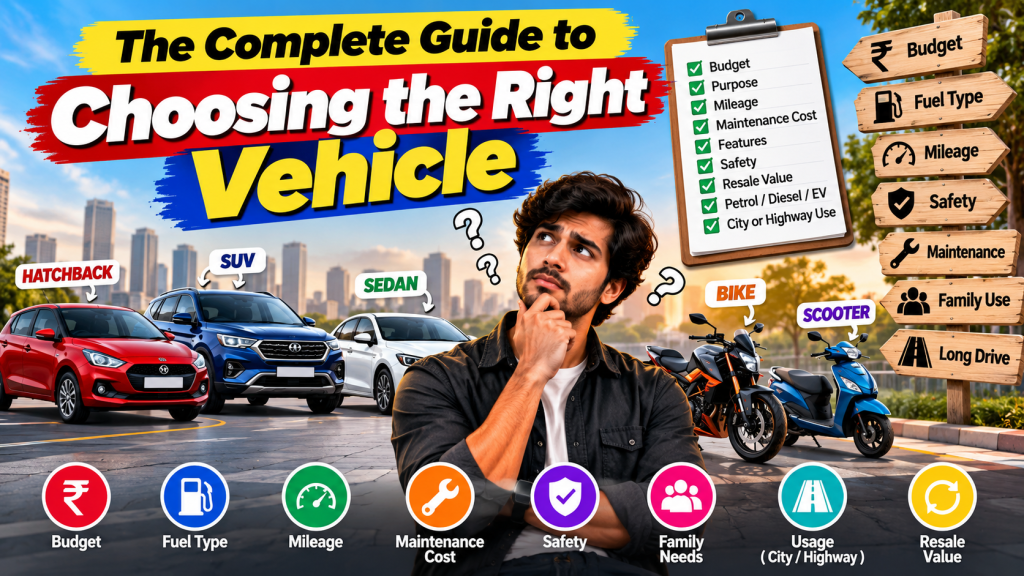
Compare the Complete Ownership Cost
Purchase price is only the beginning. A sensible comparison includes the down payment, loan interest, insurance, registration, fuel or electricity, servicing, tyres, repairs, parking, accessories, and the likely resale value. A low-priced vehicle can become expensive if it is inefficient, costly to maintain, or financed for too long. On the other hand, a more expensive vehicle can make sense when it lasts longer, holds value better, or meets a real need. Make a one-year and a five-year estimate. For example, suppose a bike costs much less than a small car, but your work requires frequent highway travel with another family member.
The lower price does not automatically make the bike the better financial decision because the car may save time, reduce weather-related inconvenience, and provide greater utility. Cost should be evaluated against use, not only against the invoice.
Fuel, Mileage, and Daily Running
Running cost becomes important when a vehicle is used every day. For a bike, mileage often attracts attention because a small difference in fuel efficiency can add up over many kilometres. For a car, fuel economy matters too, but it is only one part of the equation. Think in terms of cost per kilometre rather than brochure mileage. Your actual result depends on traffic, road quality, tyre pressure, driving style, air-conditioning use, payload, and service condition. Electric vehicles change the calculation again because charging cost, home-charging access, battery warranty, public charging availability, and usage pattern become important.
The practical question is not which vehicle has the highest claimed efficiency. It is which powertrain gives you a reasonable running cost with the least inconvenience for your route and lifestyle.
Safety and Comfort Are Financial Decisions Too
People sometimes treat safety and comfort as luxury features, but they can affect the true value of a vehicle. A car provides a protective cabin, seat belts, airbags, and other safety systems that a bike simply cannot replicate. A bike, meanwhile, exposes the rider to traffic and the road environment, making helmet quality, riding skill, visibility, braking, tyres, and road behavior especially important. Comfort matters because fatigue affects how easily you can complete a journey. Seat position, suspension, cabin space, climate control, noise, ride quality, and luggage capacity all influence real-world usability. When a vehicle is used daily, a feature that seems small during a five-minute test can become important after months of ownership.
A sensible buyer should therefore test the vehicle in realistic situations rather than making a decision from photographs and specifications alone.
When a Bike Usually Makes More Sense
A bike is often the practical choice for a single rider or a small number of riders who mainly travel within a city and want low purchase and operating costs. It can be particularly useful where traffic congestion is severe and parking is difficult. A bike may also be more suitable for short daily commutes where carrying capacity and passenger comfort are limited concerns. However, the buyer should still account for protective gear, insurance, maintenance, seasonal weather, and the risk of accidents. It is also important to consider whether an older family member or a child will frequently travel as a passenger.
What works for a single office commute may not work for family errands. A bike is not merely the cheaper option; it is a different transportation solution.
When a Car Usually Makes More Sense
A car tends to become more attractive when regular passengers, long-distance journeys, luggage, weather protection, or greater comfort are important. Families often value the flexibility to transport several people, groceries, school bags, luggage, or equipment in one trip. A car can also be useful when travel is frequent during monsoon season, at night, or on highways. The financial question is whether that added utility is worth the higher fixed and running cost. A common mistake is buying a large car because it feels safer or more premium without considering that the added size may increase fuel use, tyre costs, service costs, parking difficulty, and the loan burden.
Choose the smallest vehicle that comfortably meets your genuine needs rather than paying for unused capacity.
Finance the Choice, Not the Emotion
Vehicle loans can make an expensive purchase look affordable because the monthly EMI is smaller than the total price. Always calculate the total repayment. Compare the down payment, interest rate, processing charges, insurance financed inside the loan, and loan tenure. A longer tenure may reduce the EMI but can increase total interest and keep you in debt for more years. Try to keep the vehicle loan compatible with the useful life of the vehicle and your broader financial plan. If a monthly payment requires you to skip savings, delay debt repayment, or use a credit card for routine expenses, the vehicle is probably too expensive.
A good purchase leaves room for emergencies, insurance, maintenance, and future goals.
Use a Simple Decision Framework
A practical way to decide is to score each option from one to five on purchase cost, running cost, safety, comfort, passenger capacity, parking convenience, highway suitability, maintenance, resale, and emotional satisfaction. Then give extra weight to the three factors that matter most in your life. If daily city commuting dominates your needs, running cost and agility may receive more weight. If family travel dominates, safety, comfort, and space may receive greater weight. This avoids the common trap of choosing the vehicle that looks best in a showroom. A spreadsheet or even a simple notebook is enough.
The goal is not mathematical perfection. The goal is to force yourself to compare the same factors for both choices.
The Bottom Line
There is no universal winner between a car and a bike in India. The correct decision depends on usage, household needs, climate, road conditions, parking, safety expectations, and financial capacity. A bike can provide efficient mobility at a relatively low cost, while a car can deliver comfort, weather protection, space, and broader family utility. The smartest purchase is the one that remains affordable after you include insurance, fuel, maintenance, and unexpected repairs. Think about your real journeys, not the showroom excitement. A vehicle should support your life and your finances, not force your finances to support the vehicle.